Biography
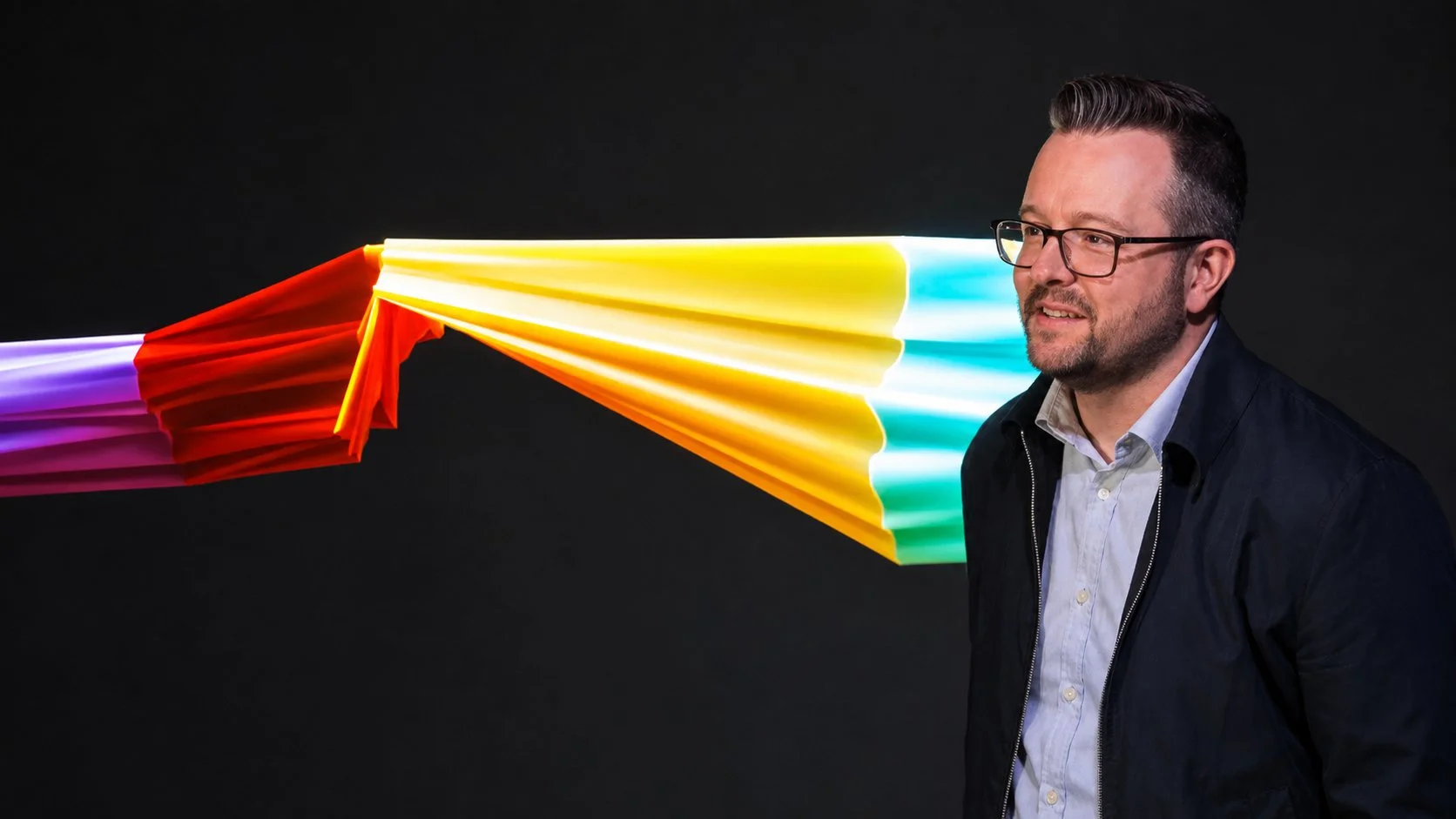
Ed S. Johnston is a computational artist and designer working across moving image, digital fabrication, and immersive installation. He develops Voxelations, digital and physical structures that carry temporal order into three-dimensional configurations. Using generative processes and 3D modeling, he explores the formal and aesthetic possibilities of transforming recorded experience into spatial form.
Johnston’s work has been presented internationally in exhibitions, screenings, and academic conferences, including ACM SIGGRAPH, the CVPR Art Gallery, Generative Art Venice, ISEA, and MODE. His work was selected for the Lumen 50 and included in the Lumen Prize’s international touring exhibition. He has received artist grants from the D.C. Commission on the Arts and Humanities, Jean Paul Slusser Fellowships, and multiple Kean University faculty grants.
Alongside his studio practice, Johnston leads and contributes to collaborative research in extended reality and experiential design. These interdisciplinary projects use immersive media to support public engagement, spatial storytelling, and the interpretation of historical and cultural material. His writing and collaborative research have been published by Springer, arthistoricum.net, and in international conference proceedings. Collaborative projects he co-directed have received a Viddy Platinum Award and a New York Emmy nomination. He is an Associate Professor in the Robert Busch School of Design at Kean University’s Michael Graves College.
Artist Statement
My current work begins with collecting image sequences. In my recent series Lucid Voxelations, a drive through autumn trees becomes a sequence of openings in the sky drawn from individual frames. I trace these shapes and sample their colors. I then position, extend, and connect them along a spatial timeline to create animations and sculptural forms. I call this approach Voxelism: a computational method for transforming ordered image sequences into spatial form by selecting, extending, and connecting bounded regions across time.
As I work, I navigate relationships of shape, color, sequence, and duration, developing assemblages through an exchange between generative processes and compositional decisions. Emerging forms, rhythms, and spatial relationships inform further arrangements and revisions. I use the passage of time as material for formal exploration and artistic expression, creating cross-media experiences that invite audiences into a process of aesthetic discovery.